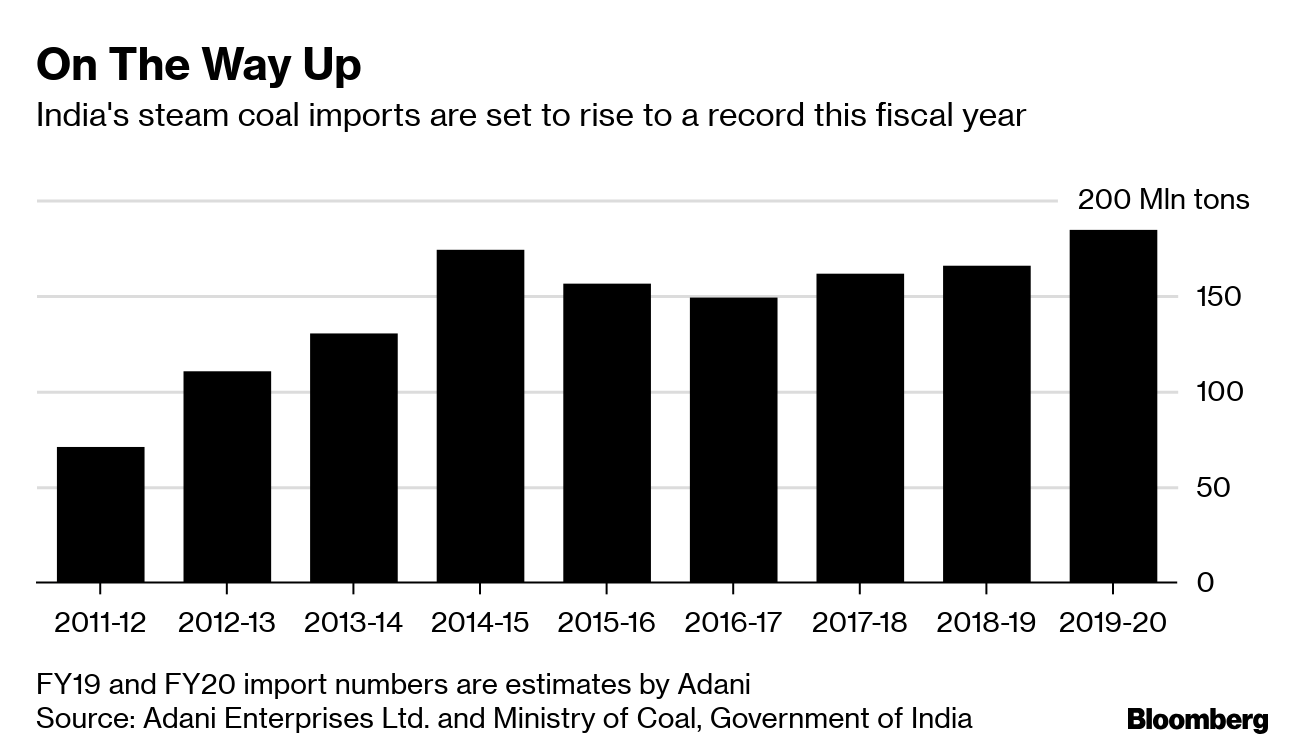
An unprecedented paradigm shift is evolving in the energy commodities trade of India, the world’s third-largest oil consumer after the US and China, and second largest oil importer after China importing over 85 percent of its crude needs. Despite being the second largest coal producer in the world, India is also the world’s second largest coal importer as new power plants designed to use only high grade imported coal (17.6 GW or 8.6% of the 204.9 GW installed power generation capacity) while older power plants import the fuel for blending with domestic coal according to S&P Global. Indian Ministry of Commerce’s Export & Import Data Bank (EIDB) points to crude oil imports worth US$ 122.45 billion and around 173.32 million tons of coal imports worth US$ 30.6 billion in the year 2021-22.
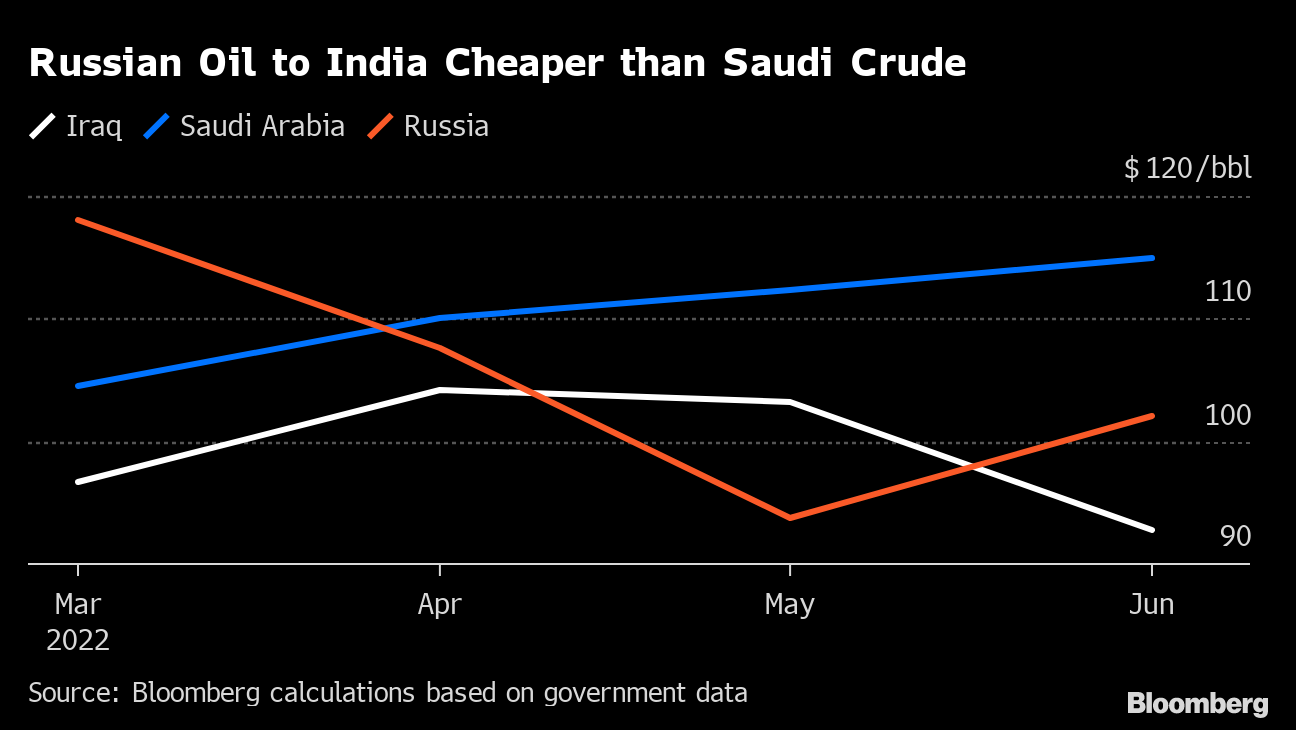
In a new paradigm shift, according to analysis by Bloomberg, Russia surpassed Saudi Arabia as the second-biggest supplier of crude to India in June 2022, ranked just behind Iraq.
In comparison, India’s imports of U.S. oil and gas commodities which grew from $4.1 billion in 2018 to $5.5 billion in 2020 roughly halved by July 2021 and the US is no longer among India’s top oil suppliers according to the oil ministry’s Petroleum Planning & Analysis Cell.
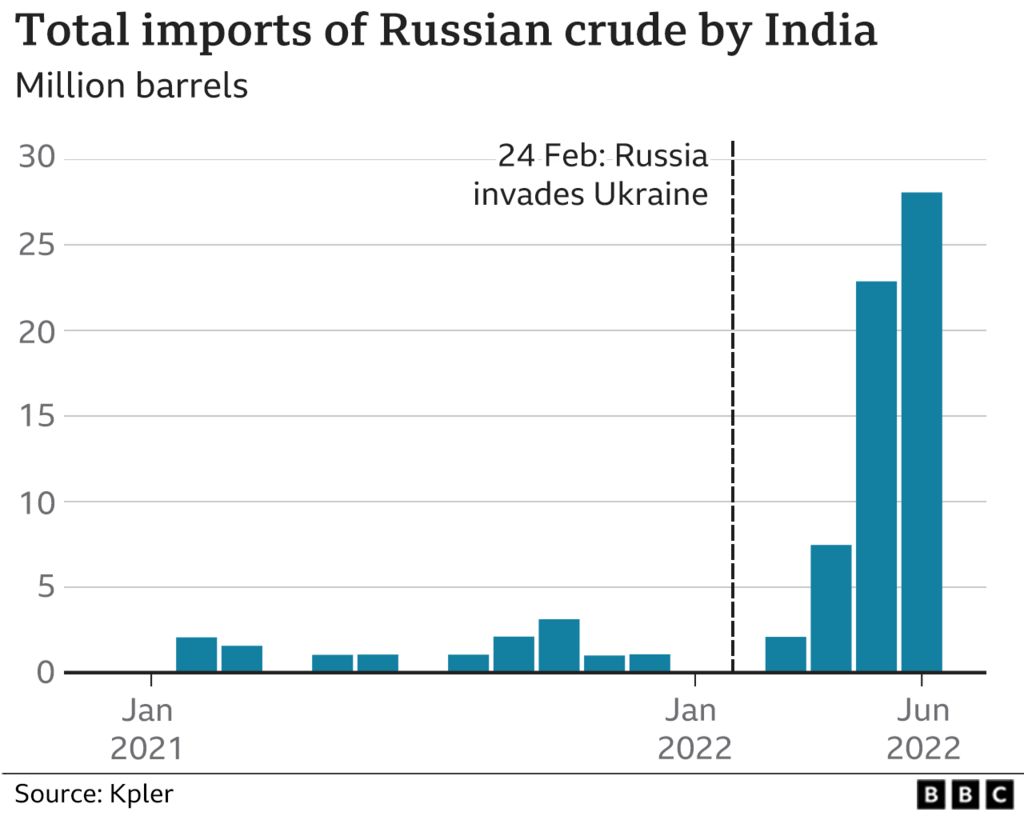
With economic growth expected to rise to 8% this year, Indian state refiners which dominate fuel retailing are in the market for the lowest priced crude that works with their refinery and product configurations via open tenders. The discount of Russian Urals crude to Brent crude was around $30 per barrel with bigger discounts to other medium-sour grades typically sold to India such as Oman and Upper Zakum reflecting the huge risk premium the market requires to transact on Russian cargoes according to Kpler. In 2021, only around 2% of India’s total oil imports (12 million barrels or 33,000 barrels a day on average of Urals crude) came from Russia, according to Kpler.
Urals oil contracts for India rose from nothing in January 2022 to 300,000 barrels a day in March to 700,000 a day in April totaling around 26 million barrels ending June 2022 according to Kpler. The India-bound Russian tankers head into Jamnagar, in the western state of Gujarat, where Reliance Industries has the world’s largest refinery complex, and into the Vadinar refinery of Nayara Energy an affiliate of Rosneft, the Russian state company which alone imports crude oil worth about $1bn every month or 400,000 barrels per day on average.
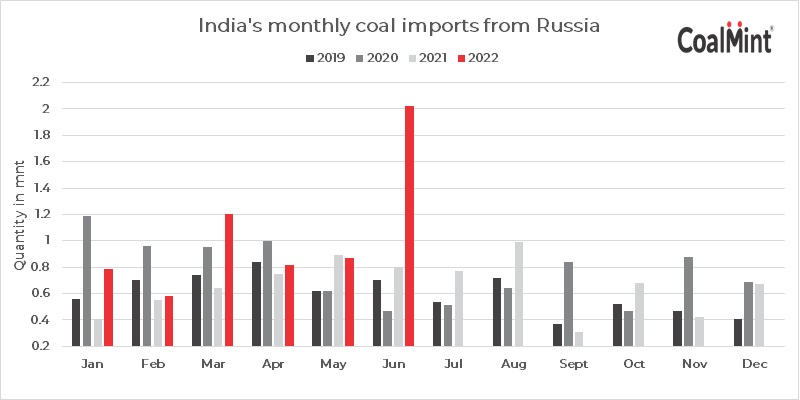
This paradigm shift in India’s energy trade is not limited to oil. Russia became India's third-largest coal supplier in July 2022 after Indonesia and Australia, with imports from Russia jumping 70.3% to a new record of 2.06 million mt, per Coalmint data. In comparison, thermal coal imports from the US fell 52% on the year to 3.4 million mt over the same time. Russian imports to India are expected to rise even higher due to a wider coal shortage during the third quarter of 2022 exacerbated by higher electricity demand.
Steep discounts offered by Russian suppliers for thermal coal and Urals crude as global prices trade at near-record highs due to western sanctions are not the only reason for this paradigm shift. India is also exploring alternative payment channels for trade with Russia including allowing payments for energy commodities in the Indian rupee or settling the trade in other Asian currencies furthering this new paradigm.
A blog focused on educating global physical energy commodities participants on evolving financial, regulatory and marketing developments in the Asian commodities markets including use of cryptocurrencies in physical commodities trading. This blog seeks to educate market participants only and does not constitute financial advice.
Monday, 15 August 2022
Sunday, 7 August 2022
Two decoupled energy blocs with India and the Gulf in the middle
Australia’s Strategic Policy Institute opined on the emergence post Russia’s invasion of Ukraine, of two decoupled energy blocs with China and Russia on one side, and Europe, North America, and the Indo-Pacific democracies, on the other side. Prior to Russia’s invasion of Ukraine, in 2020 almost 30% of EU crude oil imports came from Russia and over 40% of natural gas imports came from Russia while more than half of solid fossil fuel (mostly coal) imports originated from Russia (54 %). European nations are now seeking new sources of gas, oil and diesel fuel from the Americas, Africa, the Middle East, and India, as well as an increased focus on local energy production to wean themselves off Russian energy sources.
With Russian oil banned in the United States and Europe, India finds itself in the middle of the two decoupled energy blocs buying Russian crude at substantial discounts, powering its energy-thirsty economy at a lower cost, and refining into products like diesel and jet fuel to sell at better-than-usual margins abroad. Ironically, Europe is eager to buy the same Russian crude after it is refined in India into diesel shipping the fuel to Europe since March 2022, with increased trade flows expected over the coming months. China buys 50% of its oil supplies from the Gulf.
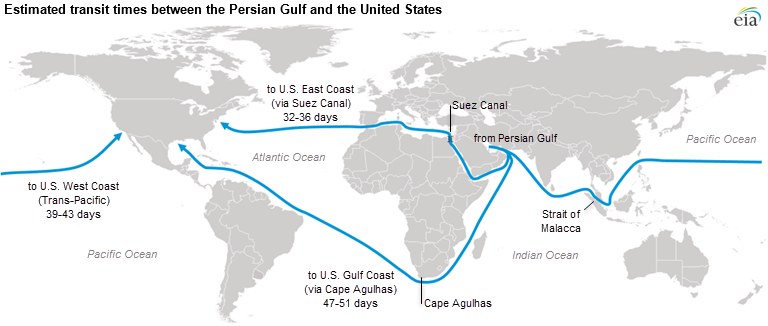
The Strait of Hormuz is the most important chokepoint between the two decoupled energy blocs accounting for about a third of the world’s sea-borne oil (and a fifth of the world’s total oil exports), linking oil and gas Upstream producers in the Middle East with Downstream consumers in Europe, North America, China and Indo-Pacific.
In 2016, according to America’s Energy Information Administration, the waterway carried some 19m barrels of crude and other petroleum products a day. This volume will accelerate through 2030 because of new mega refineries in the Gulf China and India and growing demand in Europe and emerging markets. According to Bloomberg, State-run Qatar Energy’s six new gas-liquefaction plants are set to produce 8 million tons of LNG per year for export to Europe. Morgan Stanley forecasts global LNG consumption to rise by 60% through 2030.
With Russian oil banned in the United States and Europe, India finds itself in the middle of the two decoupled energy blocs buying Russian crude at substantial discounts, powering its energy-thirsty economy at a lower cost, and refining into products like diesel and jet fuel to sell at better-than-usual margins abroad. Ironically, Europe is eager to buy the same Russian crude after it is refined in India into diesel shipping the fuel to Europe since March 2022, with increased trade flows expected over the coming months. China buys 50% of its oil supplies from the Gulf.
The Strait of Hormuz is the most important chokepoint between the two decoupled energy blocs accounting for about a third of the world’s sea-borne oil (and a fifth of the world’s total oil exports), linking oil and gas Upstream producers in the Middle East with Downstream consumers in Europe, North America, China and Indo-Pacific.
In 2016, according to America’s Energy Information Administration, the waterway carried some 19m barrels of crude and other petroleum products a day. This volume will accelerate through 2030 because of new mega refineries in the Gulf China and India and growing demand in Europe and emerging markets. According to Bloomberg, State-run Qatar Energy’s six new gas-liquefaction plants are set to produce 8 million tons of LNG per year for export to Europe. Morgan Stanley forecasts global LNG consumption to rise by 60% through 2030.
Labels:
Downstream,
EU,
European Economy,
Gulf,
India,
Oil trading,
Russia,
Strait of Hormuz,
Upstream
Location:
New Jersey, USA
Saturday, 6 August 2022
The Downstream dilemma - keep investing, or cash in now on what might be refining’s last golden age
In India, several new refineries, petrochemical projects, as well as expansion projects for existing refineries are projected to double India’s refining capacity from the current 5 million barrels per day to 10 million barrels per day by 2030. In the Gulf, four new mega-facilities totaling almost 1.4 million barrels per day are already operational or shortly going live in Jazan, in south-western Saudi Arabia, Al Zour in Kuwait, Karbala in Iraq, Duqm in Oman. Abu Dhabi’s Adnoc Ruwais refinery and Dubai’s Enoc Jebel Ali refinery have raised refining capacity in 2020. Fujairah, Egypt, Iran, Iraq, and Bahrain have also implemented various other refining expansions and upgrades. In Nigeria, a giant new refinery is expected to begin processing in the third quarter of 2022. Saudi Aramco is making new refining investments in Poland and China.
This endless demand for refining capacity with economies of scale, maximizing the output of high-value products may be close to a peak due to increasing fuel efficiency, competition from biofuels, rise of electric vehicles and pressures from climate action groups. Current fuel shortages caused by Russia’s invasion of Ukraine may ease but with a projected global economic slump in the last two quarters of 2022 the Great 2022 Downstream boom is bound to come to an end.
These new refineries may be harbingers of refining’s last golden age as among global refining mainstays, oil demand in Europe has been in decline since 2006; in Japan, since 1996. Refineries need constant investment to meet tightening safety and environmental standards, a changing demand mix for fuel, the capital cost of the facility, a host of other expenses and liabilities from unionized workforces, pensions, pollution legacies from less stringent eras as well as carbon prices. Oil majors Shell, BP and TotalEnergies have been selling or closing refineries or converting them to biofuels processing or storage terminals to cash in now on refining’s last golden age.
This endless demand for refining capacity with economies of scale, maximizing the output of high-value products may be close to a peak due to increasing fuel efficiency, competition from biofuels, rise of electric vehicles and pressures from climate action groups. Current fuel shortages caused by Russia’s invasion of Ukraine may ease but with a projected global economic slump in the last two quarters of 2022 the Great 2022 Downstream boom is bound to come to an end.
These new refineries may be harbingers of refining’s last golden age as among global refining mainstays, oil demand in Europe has been in decline since 2006; in Japan, since 1996. Refineries need constant investment to meet tightening safety and environmental standards, a changing demand mix for fuel, the capital cost of the facility, a host of other expenses and liabilities from unionized workforces, pensions, pollution legacies from less stringent eras as well as carbon prices. Oil majors Shell, BP and TotalEnergies have been selling or closing refineries or converting them to biofuels processing or storage terminals to cash in now on refining’s last golden age.
Labels:
Downstream,
Gulf,
India,
Oil,
Refineries,
Refining margins
Location:
New Jersey, USA
Tuesday, 2 August 2022
The Great 2022 Downstream boom
Refiners are enjoying the best of times as of mid-2022: Saudi Aramco’s 1Q22 upstream profit improved 75 per cent on higher crude prices and production but downstream, including refining, gained 130 per cent. In the downstream business, margins in the spread between the input cost of crude oil and the prices of outputs typically hover between $2 and $5 a barrel and frequently go negative.
As of mid-2022, refining margins have soared above $30 a barrel on a global basis and $50 in some locations as China cut its refineries’ export quotas by more than half while diesel stocks in Europe, US and Singapore have drained to multi-year lows. Even though crude prices are, historically speaking, not that high, the squeeze on refined products due to Opec+ production restrictions, sanctions on Russia, Iran and Venezuela, crimp the availability of diesel-rich, medium-gravity crude oils driving end-user prices to records ($176 a barrel for diesel in the UAE in mid-2022).
Labels:
Downstream,
Oil,
Opec+,
Refineries,
Refining margins
Location:
New Jersey, USA
Subscribe to:
Comments (Atom)